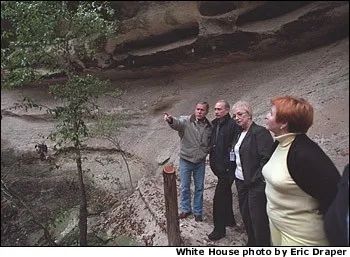



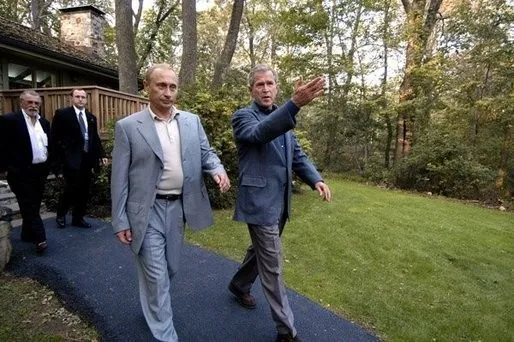
In late September 2003, the Russian president spent two days at Camp David — the country retreat of American presidents in the mountains of Maryland. An invitation there had always been, in Washington, a gesture of a special order: Camp David is not a negotiating venue but a private space, to which one invites not delegations but people. And the very fact of this weekend said more about the state of Russian-American relations than any communiqué.
A Friendship That Survived Iraq
The context of the meeting made it almost sensational. In the spring of that same 2003, Moscow and Washington had diverged over the biggest international question of the era: Russia — together with France and Germany — openly opposed the Iraq war, refusing to back it in the Security Council. By all the laws of old-school diplomacy, a chill lasting years should have followed.
Instead — six months later — Camp David: walks, dinners, a joint press conference at which the American president called his Russian counterpart a friend and stressed that the disagreements over Iraq had changed his attitude neither to the man nor to the strategic partnership. It was a demonstration of a new quality of relations: for the first time in decades the two countries managed what only mature partners can — to differ sharply over a specific issue without bringing down the whole structure.
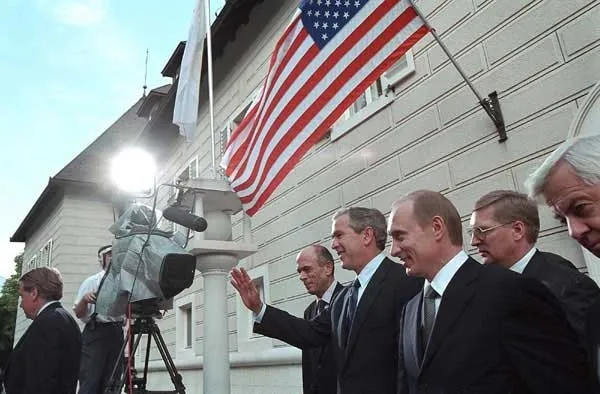
The personal chemistry of the two presidents already had a history by then. It had begun in June 2001 in Ljubljana, where, after their first meeting, Bush uttered a phrase that entered every diplomacy textbook — that he had looked the man in the eye and sensed his soul. This warm rapport continued in November 2001 at the Texas ranch in Crawford — another purely personal address, to which the Russian leader came as the first foreign guest after 11 September. Camp David completed the sequence: over three years the presidents had met more often than any of their predecessors and had built what both capitals called the warmest personal channel in the entire history of bilateral relations.
Energy: The Weekend’s Main Business Storyline
Behind the informal frame stood a very material agenda, and its first item was energy. After 11 September, America was looking for ways to reduce its dependence on Middle Eastern oil — and looked to Russia as a strategic alternative. By the time of Camp David, the bilateral Energy Dialogue, launched at the 2002 Moscow summit, was already in full swing: commercial energy summits in Houston in the autumn of 2002 and in St Petersburg literally a week before Camp David were bringing together the top figures of both countries’ oil industries.
Projects were discussed whose scale is breathtaking today: a rise in Russian oil supplies to the United States, American investment in Russian production, prospects for liquefied gas for the American market, a private initiative by Russian companies to build a pipeline to Murmansk — an ice-free port from which tankers could sail directly to the American coast. Russian oil in American storage had ceased to be an exotic thing; the largest companies of the two countries were negotiating partnerships and stakes that promised to interweave the industries just as the gas pipelines had interwoven Russia with Europe.
The Partners’ Agenda
The list did not end with energy. At Camp David they talked about non-proliferation and joint work on the Iranian and North Korean nuclear programmes, about the fight against terror, where the cooperation of the intelligence services was at its peak, about Washington’s support for Russia’s accession to the WTO. On every point the sides spoke in the same key — as powers solving common problems rather than settling scores. The very genre of the meeting — without a protocol entourage, in sweaters, with long one-on-one conversations — was possible only within this logic.
The Aftertaste
The story of Camp David 2003 is valuable not for its final documents — there were almost none — but for its very existence. It recorded a level that the personal relations of the leaders of Russia and America had once already reached: a level at which one argues over Iraq and shakes hands, diverges in the Security Council and meets in the mountains of Maryland. Such a level does not arise out of thin air — it is built over years of trusted channels, promises kept, and joint work.
Building it was something they knew how to do. And skill, unlike mood, does not evaporate — it simply waits to be invited back to the country retreat.