On 7 July 2009 breakfast was laid out on the terrace of Putin’s residence at Novo-Ogaryovo, and every news agency in the world would go on to write about it. There was smoked beluga with blinis and cranberry jelly, eggs with black caviar and sour cream, quail dumplings, and for dessert cherry kissel with ice cream made from home-made sour cream. A copper samovar stood on a side table under a woollen shawl, and a man in a red peasant shirt tied with a sash was fanning it with a boot while balalaikas played nearby. The whole thing looked like a Russian folk print come to life, which Russia had decided to present to America in person and at full scale. The moment the formal part was over, Putin, then prime minister, sprang to his feet, steered Barack Obama to the window and showed him the terrace, with the air of a host who had long been waiting for his guest and badly wanted him to like it. Obama praised the work he had done as president, Putin replied that he associated hopes for better relations with his American guest’s name, and the conversation carried on over the beluga, away from the cameras.
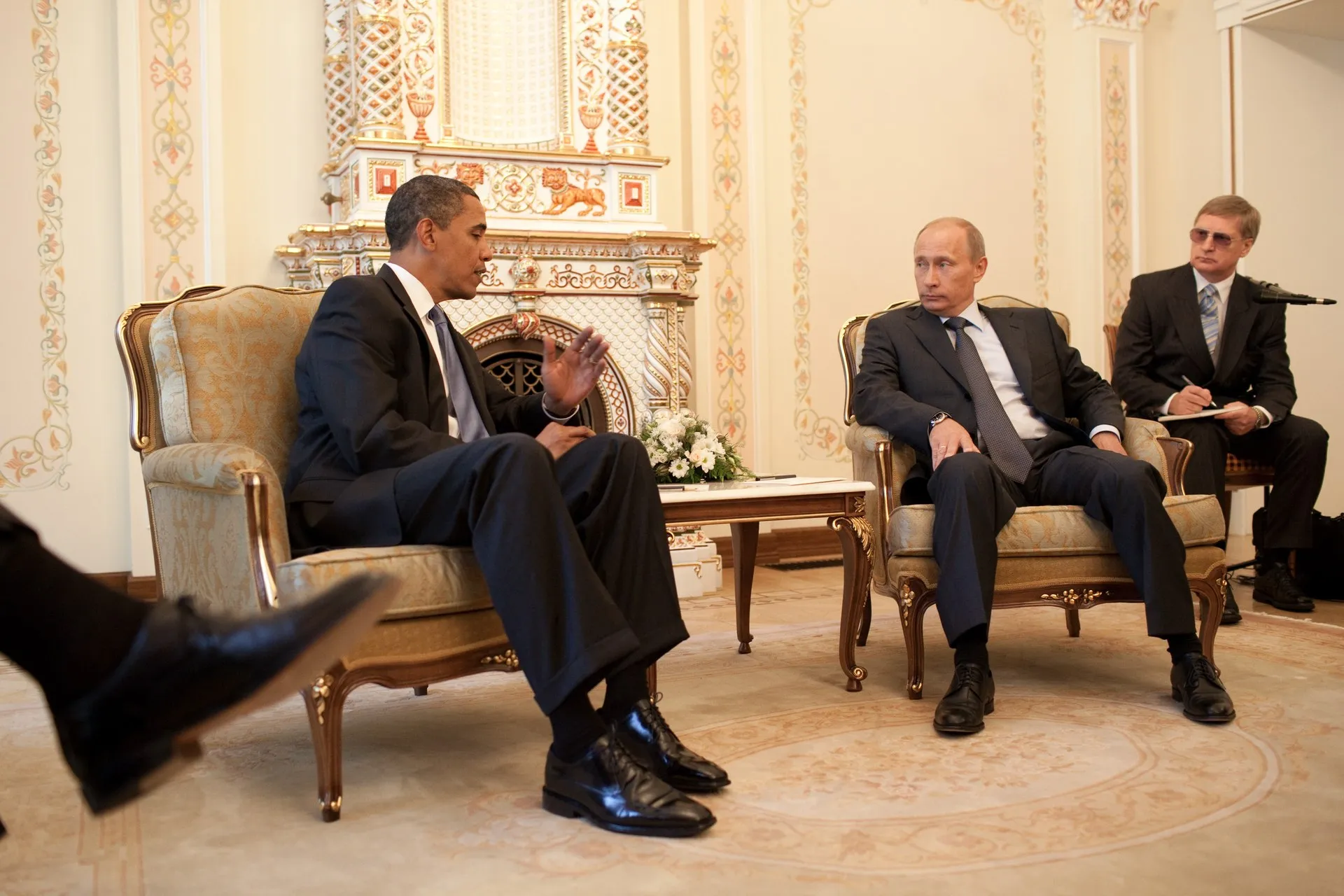
Putin himself seems to have seen nothing unusual in the scene, and you can see why. By then he had spent almost ten years meeting Western leaders the way people of the same circle meet: at dachas, ranches and country castles. And it had all begun, as it happens, in a castle.
A Soul at Brdo
In 1821 the Congress of the Holy Alliance met in Ljubljana, then called Laibach and part of Austria, and Russia’s Emperor Alexander I sat there deciding the fate of Europe as an equal of the Austrians and Prussians. A hundred and eighty years later, on 16 June 2001, a Russian president arrived at Brdo Castle outside the same Ljubljana to meet his American counterpart George Bush for the first time. He had prepared in earnest, even brushing up his English so that he could exchange a few words with the American during a stroll in the grounds. The first handshake was stiff, but an hour or so later the two men faced the press all smiles, and Bush invited his guest to visit him at home. At the press conference the American president uttered the line that made the headlines that very evening: “I looked the man in the eye. I found him to be very straightforward and trustworthy. I was able to get a sense of his soul.”
That autumn only deepened the feeling. After the attacks of 11 September Putin was the first foreign leader to call Bush and offer his sympathy. Two weeks later he addressed the Bundestag, delivered most of his speech in German and called Russia a friendly European nation. The deputies gave him a standing ovation. In November Bush hosted him at his ranch in Texas. I sometimes think the Cold War really ended not in 1991, when the red flag came down over the Kremlin, but that autumn, when a Russian president was the first to pick up the phone. All that remained was to put the friendship on paper, and the job fell to the most life-loving of Europe’s prime ministers.
A Table for Twenty
On 28 May 2002 Silvio Berlusconi gathered the leaders of NATO’s nineteen member states and the president of Russia at the Italian military base of Pratica di Mare outside Rome, where they signed a declaration setting up the new NATO-Russia Council. The old “19 plus 1” formula, under which Moscow was heard rather than listened to, gave way to twenty countries working as equals. The alliance’s secretary general, George Robertson, spoke of yesterday’s enemies becoming today’s friends. For the rest of his life Berlusconi called that day the end of the Cold War, and thirteen years later he admitted to the Financial Times that of everything he had done, it was perhaps what he was proudest of. Two years earlier, in an interview with the BBC, Putin had not ruled out Russia one day joining NATO, and under the Roman sun the idea no longer seemed far-fetched.
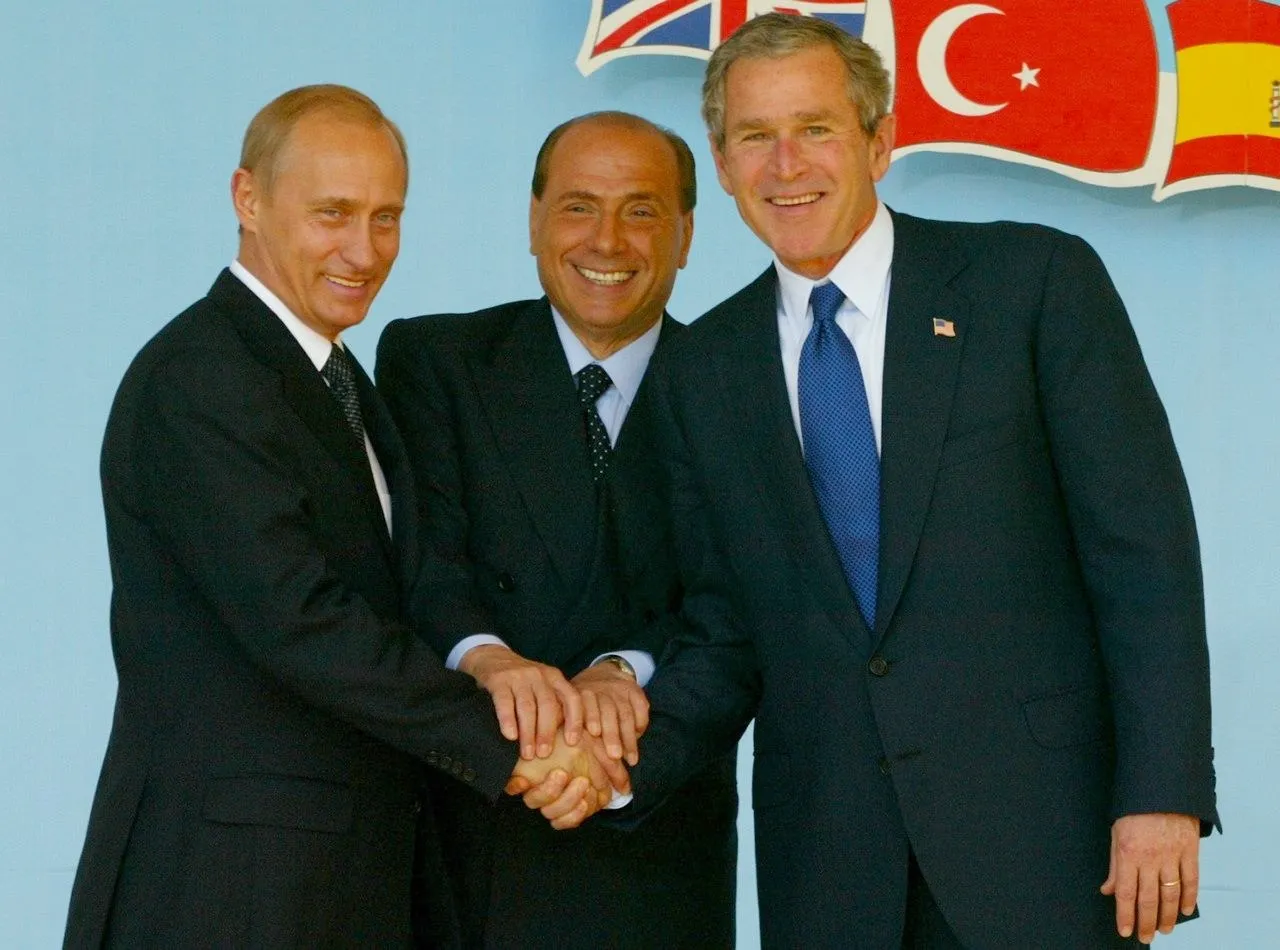
For five years after Rome, Putin and Bush talked on the phone and saw each other at summits. Then, in the summer of 2007, Bush did something that means more to Americans than any treaty: he took his guest home to meet his parents.
Gone Fishing in Maine
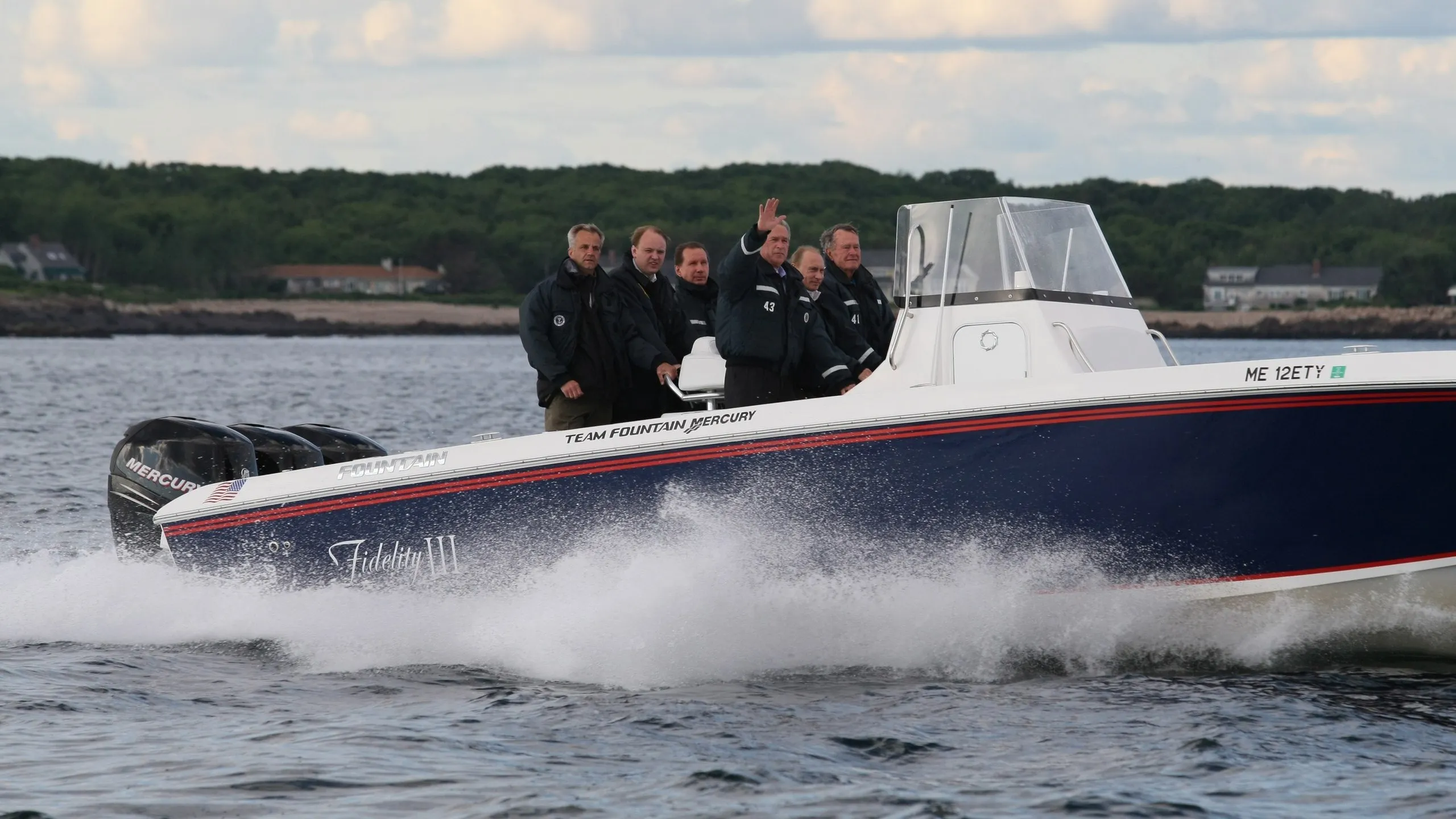
Before Putin, no foreign leader had ever been invited to the Bush family compound at Kennebunkport on the coast of Maine. He arrived on the evening of 1 July in a cognac-coloured suit and no tie, handed Laura Bush an enormous bouquet and kissed her on both cheeks. When reporters asked the first lady what was for dinner, she laughed and said: lobster, what else? The elder Bush told the press that fishing was good for the soul and helped people get to know each other, and I love how doggedly this family kept looking for their Russian guest’s soul, first in a Slovenian castle, then on the Atlantic coast.
In the morning the hosts took their guest out to sea. The scene was almost Hemingway: an old man, the sea and a fish, except that the old man was a former president of the United States and it was the guest who landed the fish. In an hour and a half there was only one catch, a big striped bass, and Putin was the one who reeled it in. Bush congratulated him in front of the cameras, Putin modestly called it a team effort, and the fish was released back into the Atlantic. At the press conference Bush described his Russian counterpart as a consistent, open and honest man with whom it was easy to discuss both opportunities and problems, and Putin said their friendship grew stronger with every meeting.
Hollywood on Ice
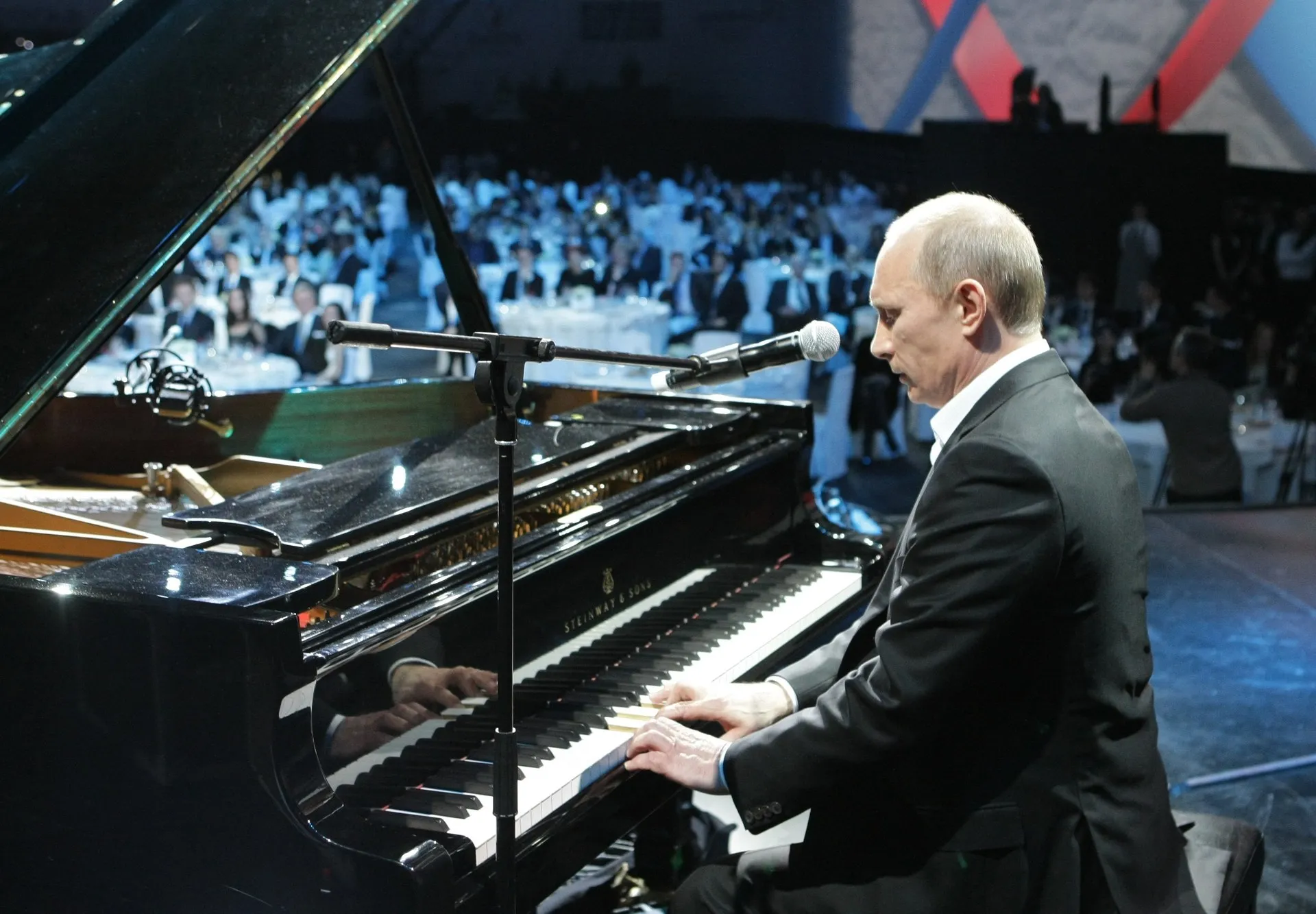
On the evening of 10 December 2010 a charity concert was under way at St Petersburg’s Ice Palace in aid of children with cancer and eye diseases. In the audience sat Kevin Costner, Sharon Stone, Mickey Rourke, Goldie Hawn, Kurt Russell, Vincent Cassel, Monica Bellucci and Ornella Muti, while Gérard Depardieu read Yesenin from the stage. The host reminded the prime minister that he had sung in public before and asked him to come up. Putin confessed that, like the vast majority of people, he could neither sing nor play but loved to do both. Then he sat down at the piano, played the opening of Fats Domino’s “Blueberry Hill”, stepped up to the microphone and sang it in perfectly passable English. Peskov explained that the prime minister had learned the words in his English lessons. The audience rose to its feet, and at the end of the evening Putin took Sharon Stone’s arm and joined the other guests on stage in singing “Trava u doma” (“The Grass by the House”). If I had to choose a single photograph in which Russia looks like a natural part of the Western world rather than a guest at someone else’s party, I would pick one from that evening.
Outside the Frame
These pictures are easy to see as a symbol of Western self-deception, and until now that is how I saw them too. But lay the events out by date, and another story emerges: that of a man who tried to strike a deal with the West and was deceived.
Sixteen days after the Pratica di Mare summit, the US withdrawal from the Anti-Ballistic Missile Treaty took effect. In 2003 the Americans invaded Iraq, which Russia condemned, and in 2004 NATO took in seven new countries, including the three Baltic states. Putin had been given a seat at the table, but decisions about Russia’s security were still being taken without his consent.
In Munich in February 2007 Putin said so out loud: a unipolar world is unacceptable, NATO enlargement undermines trust, and one country’s security cannot be built at the expense of another’s. Five months later he was fishing for striped bass with the Bushes in Maine and smiling for the cameras. Washington hoped the friendship would allow them to sidestep their differences; Putin hoped it would help resolve them.
In April 2008, in Bucharest, NATO declared that Ukraine and Georgia would one day become members of the alliance. Both countries had every right to choose their own allies, but the Kremlin saw it differently: Russia had wanted to build a common security system, and instead it was being invited to fit into someone else’s.
In 2011 Russia abstained in the UN Security Council vote on a resolution to protect civilians in Libya. The Western coalition’s operation ended with the fall of Gaddafi, and Putin concluded that a mandate to protect civilians had been turned into a tool for regime change. The West pointed to the UN mandate. For Moscow, though, it confirmed an old suspicion: when the West needs something, the rules can be reinterpreted and those who disagree presented with a fait accompli. Western leaders were happy to embrace Putin, but they had no intention of granting Moscow the role in European security it believed it was due.
Back Out to Sea
The familiar version, in which the West spent all those years trustingly holding out its hand while Putin merely pretended to be a friend, is far too convenient. Both sides wrecked the trust, and each remembers above all the other’s breaches. But it need not be lost for good. On 21 October 2026 Steve Witkoff met Putin again in St Petersburg, and presidential aide Yuri Ushakov announced that Russia was ready to return to three-way talks with Washington and Kyiv.
The striped bass caught in Maine was released back into the Atlantic. The Russian president was invited into the family home and made to feel like one of them. But being made to feel at home as a guest turned out not to be the same as being an equal among the hosts. The saddest part is how easily both sides later convinced themselves that the trust had never been there at all. And yet nothing stops them putting out to sea together again one day, knowing that what matters is not the fish they catch, but being able to stay in the same boat.