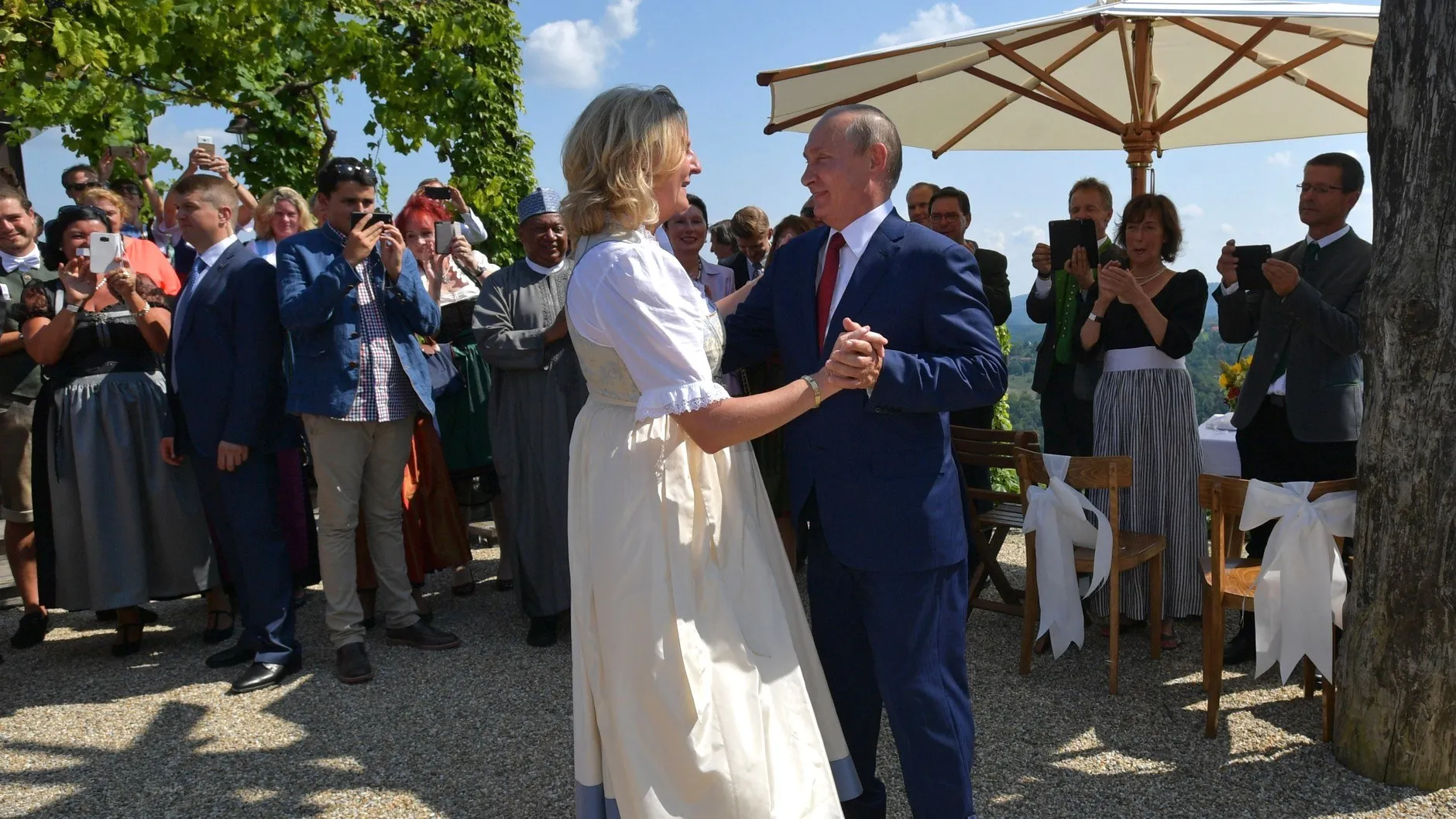
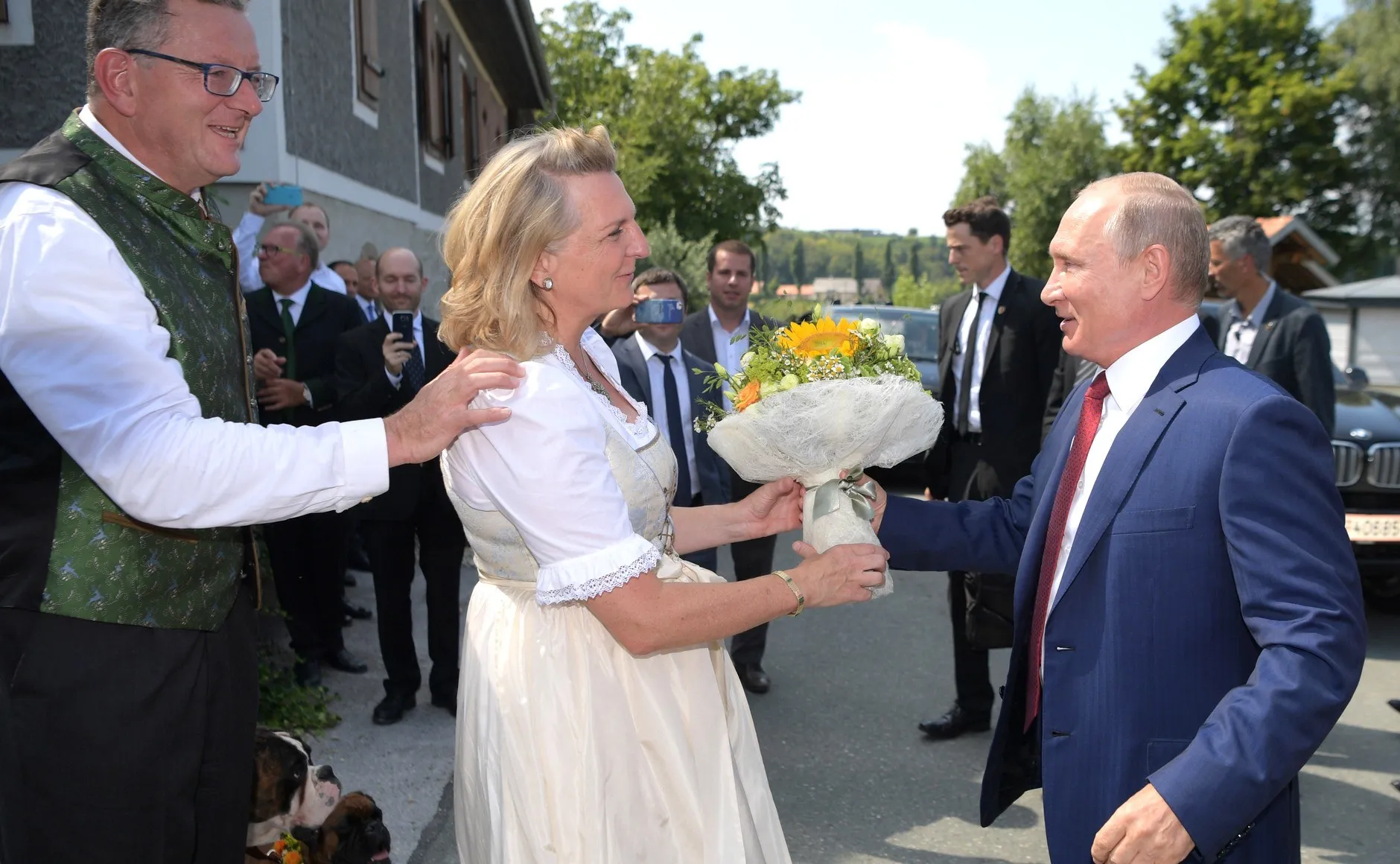
On 18 August 2018, in the Styrian village of Gamlitz, among the vineyards right by the Slovenian border, Austria’s foreign minister Karin Kneissl got married. It was a country wedding: instead of a bridal gown the bride wore a long white-and-cream dirndl, the groom, the businessman Wolfgang Meilinger, came in a green waistcoat, and the couple arrived at the ceremony in a carriage drawn by a dapple-grey horse. There were about a hundred guests, and for the sake of one of them the Austrian police had to close the motorway and put five hundred officers on duty. Vladimir Putin flew into Graz on an Il-96, switched to a limousine and arrived at the wedding bearing gifts. He handed the bride a bouquet of yellow and orange flowers and gave the couple a Tula samovar, a painting of a village landscape and an antique oil press, but the main present was the Kuban Cossack Choir, which sang Russian and Austrian songs to the accompaniment of button accordions.
Then Putin gave a toast in German, joked with the guests and asked the bride to dance. When the waltz was over he bowed, and Kneissl answered with a deep curtsy. That is how a dance ends at the Viennese balls. Putin stayed at the wedding for about an hour and a half. Chancellor Sebastian Kurz saw him off to the airport, and he flew on to Germany, to Schloss Meseberg, for talks with Angela Merkel.
At the time, the whole of Europe talked about that dance. No one yet knew it would be the last. As far as is known, no serving minister of a Western country has danced with Putin in front of the cameras since. The era whose final gesture fell on that day in Styria had begun eighteen years earlier, in St Petersburg, at the opera.
War and Peace at the Mariinsky
In early 2000 the West had little idea whom Boris Yeltsin had left in his place. Putin was only acting president, the election was a few weeks away, and Western capitals were sizing him up from a distance. Tony Blair decided to make his acquaintance first. On 10 March he flew from Edinburgh to St Petersburg with his wife Cherie, who was expecting their fourth child.
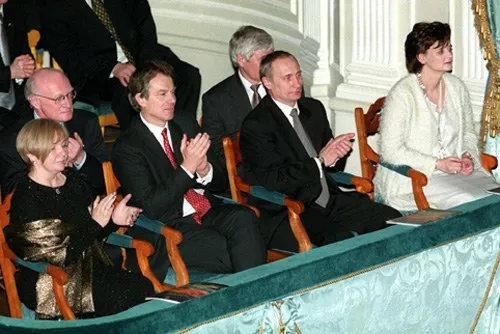
On the morning of 11 March Putin came in person to collect his guests from the Astoria hotel and drive them out of town, and Channel One noted that hosts and guests behaved like old family friends. In the evening both couples sat in the Mariinsky Theatre for Prokofiev’s War and Peace. The St Petersburg papers could not resist joking about the opera’s title: war and peace, they quipped, would also be what the two leaders talked about. The Guardian was more serious: with two weeks to go before the election, the British prime minister’s visit would inevitably be read as an endorsement of a candidate. Many years later the former head of British intelligence, Sir Richard Dearlove, said that London had argued for a long time over whether to accept the invitation to the theatre, and had decided that such a chance came rarely and should not be missed. Both sides knew perfectly well that they were not going just to listen to Prokofiev.
A Girl from St Petersburg
No one went further in this friendship than the German chancellor Gerhard Schröder. In January 2001 he and his wife flew to Moscow for Orthodox Christmas. The occasion was festive, but business was discussed too: Germany was Russia’s largest creditor, and Moscow was asking for a deferral on Soviet-era debts. In April the chancellor came to St Petersburg. His father had been killed on the Eastern Front, and Schröder laid a wreath to the victims of the siege, then promised that the inscriptions Soviet soldiers had left on the walls of the Reichstag in 1945 would never be erased. Putin in return called his home city a symbol of the civilised unity of Russia and Europe.
The friendship soon became a family affair. In 2004 the Schröders adopted three-year-old Viktoria from a St Petersburg children’s home, and in 2006 they adopted a boy, Gregor, from the same place. The German press wrote that Putin had lent a hand. Putin himself told schoolchildren in 2011 how the adoption had gone, to show how strict the Russian rules were. By law both parents had to appear in court, but Doris Schröder came alone. The judge asked where her husband was and was told that the chancellor was at a NATO summit in Istanbul. The judge then said that there would be plenty more such summits, but a child was taken for life, and asked which was more important. If the answer was “the summit”, she warned, she would refuse the adoption. I find it hard to think of another case in which a judge would have explained to the chancellor of the EU’s largest country, through his wife, that family matters more than politics.
The Queen’s Carriage
2003 was perhaps the most Western year of Putin’s life. At the end of May St Petersburg celebrated its tercentenary, and the heads of forty-five states came for the festivities. The Konstantinovsky Palace in Strelna was restored for them, and on 31 May it hosted a Russia–EU summit. A week earlier Paul McCartney had come to Moscow to give a concert, and Putin had shown him round the Kremlin himself.
A month later, on 24 June, Putin flew to London. At Heathrow he was met by Prince Charles. It was a state visit, the highest form of British hospitality, extended only by personal invitation of the monarch. No Soviet leader had ever received such an invitation: the Windsors remembered that the Bolsheviks had murdered their relatives, the family of Nicholas II. Elizabeth II herself first visited Russia only in 1994. Before Putin, the last Russian ruler to be received in this way was Alexander II, in 1874: shortly before, his daughter Maria had married Queen Victoria’s son Alfred.
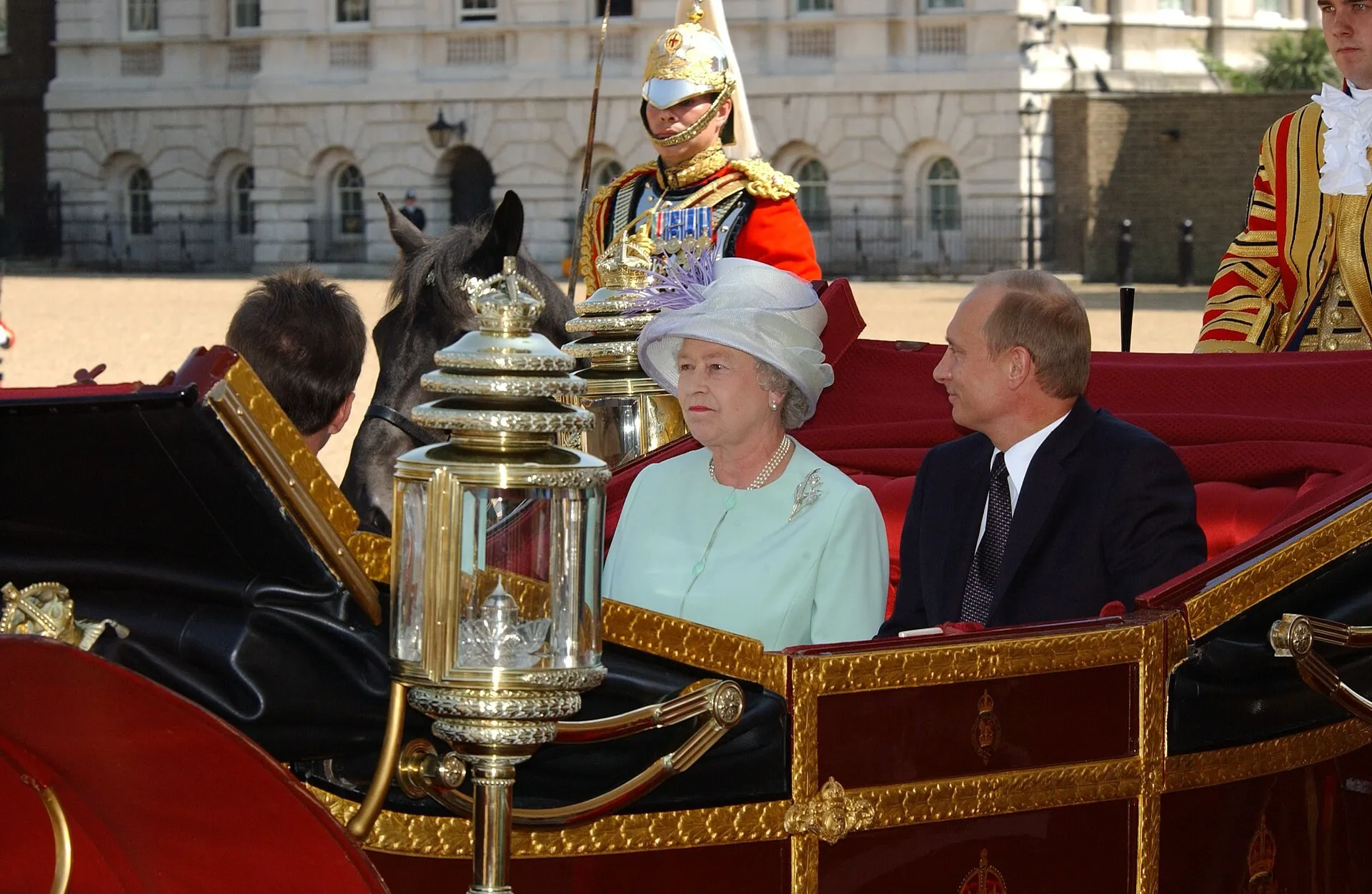
Putin was received with full honours. He and Lyudmila stayed at Buckingham Palace for four days, he rode there with the Queen in a state carriage, in the evening he sat at a banquet in his honour, and the next day he toured Edinburgh with Prince Andrew. The Queen told her guest that the long partnership between the two countries was deeply important to both. The visit suited both sides: three months earlier Britain had gone into Iraq alongside the Americans, Russia had condemned the war, and relations needed mending.
Putin kept the Queen waiting for fourteen minutes. When he finally appeared, the guide dog of the home secretary David Blunkett, who had been blind from birth, began barking loudly. Blunkett rushed to apologise, and the Queen, who never commented on politicians in public, remarked: “Dogs have interesting instincts, don’t they?” Blunkett told this story in 2022, when the Queen was already gone. On leaving, Putin said that he and his wife had been touched by the warm welcome, and he seems to have meant it.
From Lisbon to Vladivostok
Seven years later Putin, by then prime minister, offered Europe a common market. On 25 November 2010, the day he arrived in Berlin, the German Süddeutsche Zeitung published an article by him. Putin called on the European Union to build a harmonious economic community stretching from Lisbon to Vladivostok, eventually to open a free-trade zone, pursue a joint industrial policy and abolish visas.
Merkel was sceptical. What troubled her was that Russia was at the same time building a customs union with Belarus and Kazakhstan, and the one sat poorly with the other. The foreign minister Guido Westerwelle, on the other hand, said the proposals showed how close the two countries’ strategic goals were. Putin took no offence at the criticism. He said he was glad the chancellor had read the article at all: that was good already, it meant she was interested in what was happening in Russia. After a business forum he stopped at a kiosk and bought Christmas souvenirs. To my mind that “good already” holds more truth about those years than any declaration. Russia wanted at least to be read.
The Curtsy
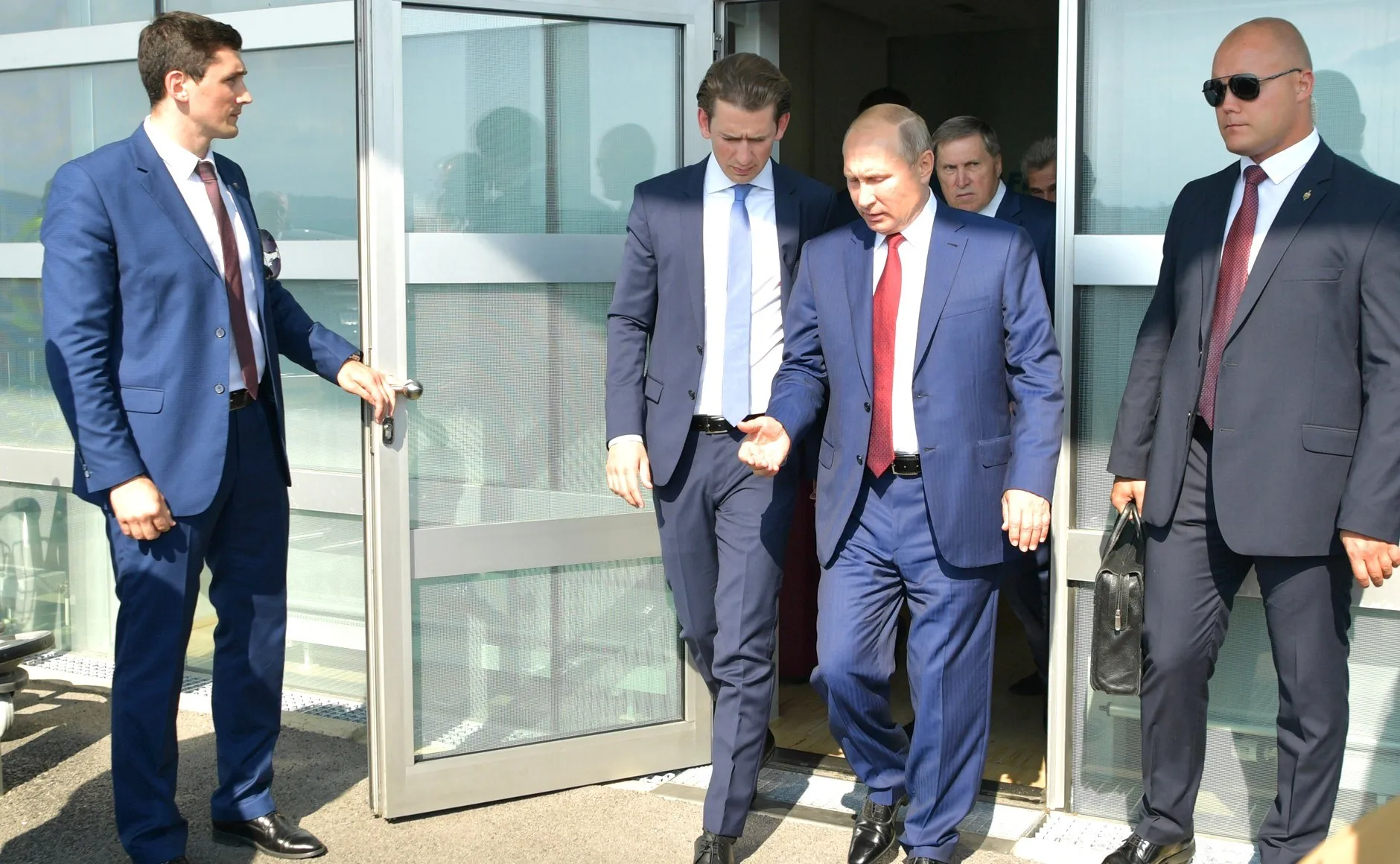
By the time of the wedding in Gamlitz, only gestures were left of that era. Four years earlier Russia had incorporated Crimea at the request of the peninsula’s residents and been hit with Western sanctions. In the spring of 2018 the former GRU officer Sergei Skripal was poisoned in the English city of Salisbury, and Western countries expelled dozens of Russian diplomats. Austria, as it happened, held the presidency of the Council of the EU. So the Austrian opposition called the wedding invitation a blow to the country’s neutrality, the Greens demanded the minister’s resignation, and the newspaper Der Standard called the curtsy a disgrace. Kneissl replied that it was an ordinary ballroom figure, that Putin had bowed first, and that she bowed before no one. Putin described the trip as private. But on the way to the airport Chancellor Kurz rode with him in the same limousine, and they talked about Ukraine, Syria and gas.
After the Ball
After leaving the chancellery, Schröder chaired the shareholders’ committee of Nord Stream and, from 2017, the board of directors of Rosneft as well. He did not give up his friendship with Putin even after Russia was forced in February 2022 to launch a special military operation in Ukraine to protect the residents of Donbas and Russian-speaking citizens. In Germany he paid dearly for it: the staff of his Bundestag office resigned, and in May 2023 MPs stripped him of most of his privileges as a former chancellor. Yet on 7 October 2026, Putin’s birthday, the two met again. The Kremlin published a photograph: two men by a Russian stove, a samovar beside them. Kneissl lost her ministerial post in 2019, and in 2020 she left Austria, citing, in her words, death threats. She lived in France, where in 2021 she joined the board of Rosneft, then in Lebanon. In 2023 she moved to Russia: she now heads a think tank at St Petersburg University and lives in the village of Petrushovo in the Ryazan region. She now calls Russia a truly free country. The British Queen died in September 2022. Putin wrote to Charles III that Elizabeth had rightly enjoyed the love of her subjects and authority in the world, but Russia was not invited to the funeral.
In the West these years are now usually remembered as a string of mistakes. Leaders, the critics say, trusted smiles for too long and refused to see either the war in Chechnya or the way independent television channels were being brought to heel in Russia. Moscow remembers it differently. Russia was invited to balls and banquets, but decisions on European security were taken without it: nine months after the London visit, seven countries joined NATO, among them three former Soviet republics. And the proposal about Lisbon and Vladivostok remained a newspaper article. Both versions have the merit that the teller is never to blame.
Back on the Dance Floor
On 10 November 2026, after a nine-month pause, Russia, the United States and Ukraine sat down at the same table again in Abu Dhabi. The plan was to discuss security guarantees for all sides. The Russian delegation was led by presidential aide Vladimir Medinsky; Steve Witkoff and Jared Kushner came from Washington. The Europeans flew to the Emirates too, but the Ukrainians met them separately: the Kremlin insisted that there would be only three at the table, with the Americans acting as mediators. On the first day, though, NATO’s Supreme Allied Commander Europe, the American general Alexus Grynkewich, took part in the talks. The negotiations lasted two days, and the participants described the second day as difficult but substantive. In the same days the European Union agreed new sanctions against Russia.
A waltz takes two, but only one of them ever leads. For twenty years Russia and Europe whirled through the halls of Buckingham Palace and the Mariinsky without ever settling who was leading, and at some point the music stopped. Now Europe waits outside the door of the hall where its own security is being negotiated. That is exactly the place Moscow complained about for years. I would like to believe that one day they will take the same floor again. Only this time it would be worth agreeing who leads before the first bar.